
Random-Walk Microstructures for Differentiable Topology Optimization
Symposium on Computational Fabrication (SCF) 2025
Samuel Silverman, Dylan Balter, Keith A. Brown, Emily Whiting
Abstract
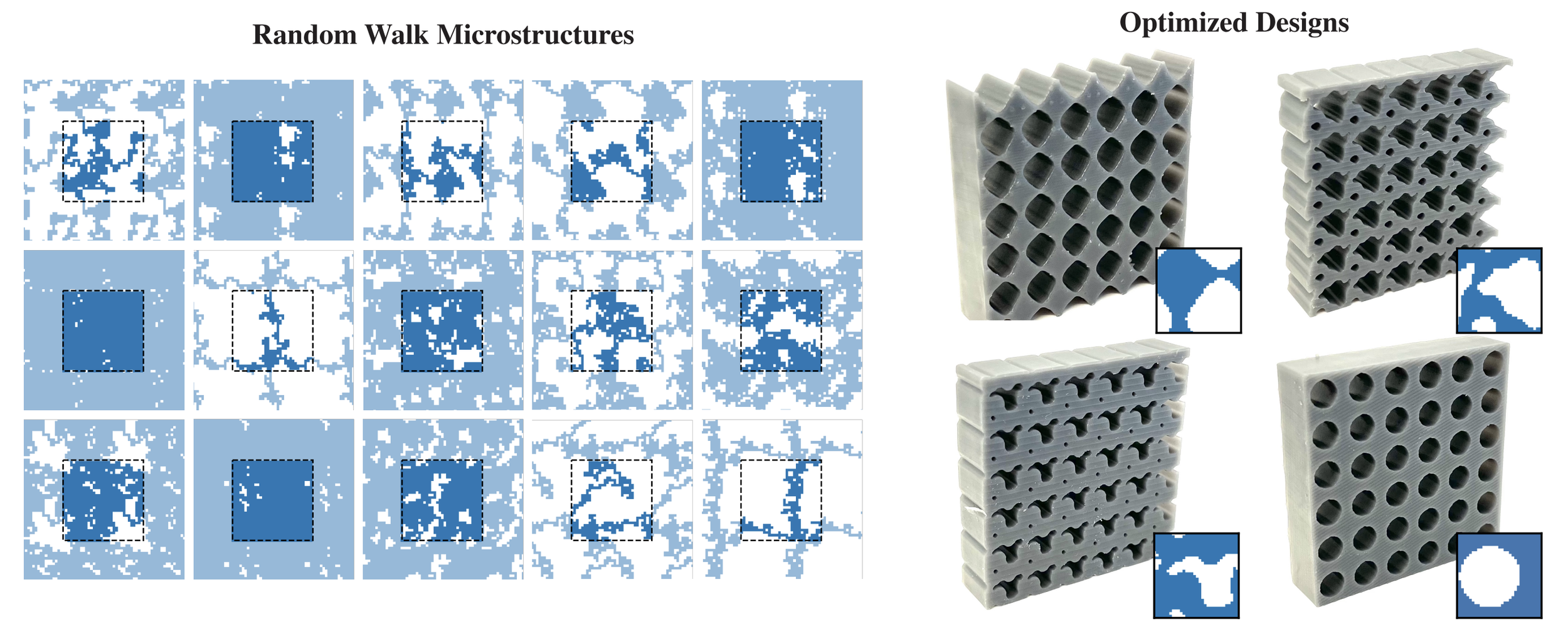
This paper presents a differentiable pipeline for topology optimization of high-resolution mechanical metamaterials on grid domains, enabling complete geometric freedom within a fixed-resolution design space. Our method begins with a microstructure generation procedure based on random walks, which avoids hand-crafted parameterizations and populates the design space without strong geometric priors, yielding a diverse set of mechanically meaningful microstructures. We train a convolutional neural network to predict homogenized stiffness tensors from these microstructures, enabling a fast and differentiable approximation of mechanical behavior without the need for finite element solves. By plugging this surrogate into a topology optimization loop, we can backpropagate through mechanical objectives and discover high-resolution, fabricable designs across a wide range of densities and target behaviors. We demonstrate our pipeline’s inverse design capabilities, producing microstructures with both isotropic and anisotropic stiffness, and validate our predictions through mechanical testing.
Bibtex
@inproceedings{SCFSilverman_2025,
author = {Silverman, Samuel and Balter, Dylan and Brown, Keith A. and Whiting, Emily},
title = {Random-Walk Microstructures for Differentiable Topology Optimization},
year = {2025},
publisher = {Association for Computing Machinery},
address = {New York, NY, USA},
doi = {10.1145/3745778.3766645},
booktitle = {Proceedings of the ACM Symposium on Computational Fabrication},
articleno = {25},
numpages = {11},
keywords = {microstructures, random walks, inverse design, neural networks, homogenization},
series = {SCF '25}
}